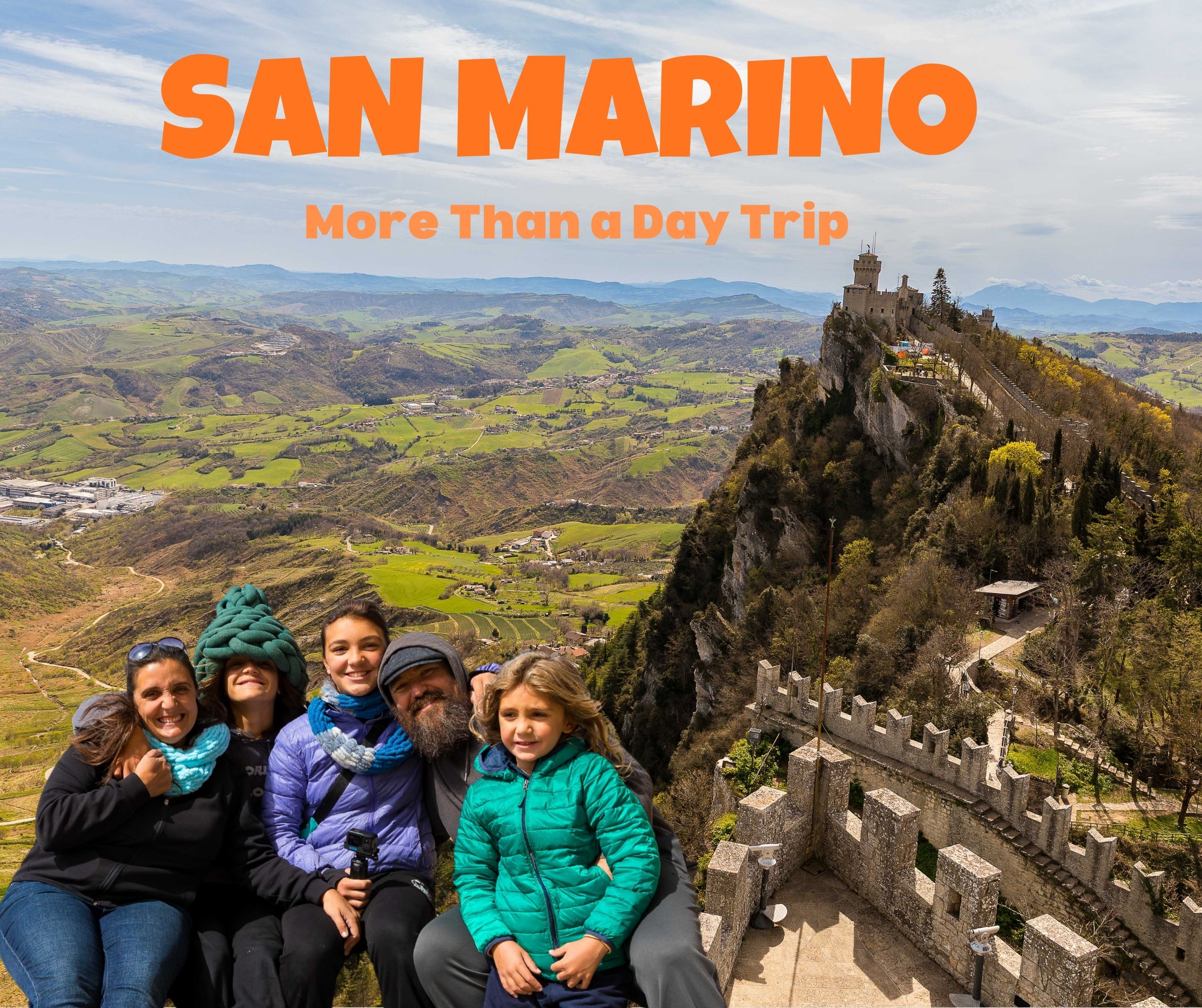
When most people plan a trip to Italy, San Marino rarely makes the list.
And yet, during our travels in 2023, this tiny republic became our 46th country, and one of the most unexpected places we’ve visited.
The Republic of San Marino isn’t just a beautiful medieval town perched on a mountain. It’s a fully independent country, with its own government, laws, and identity, entirely surrounded by Italy.
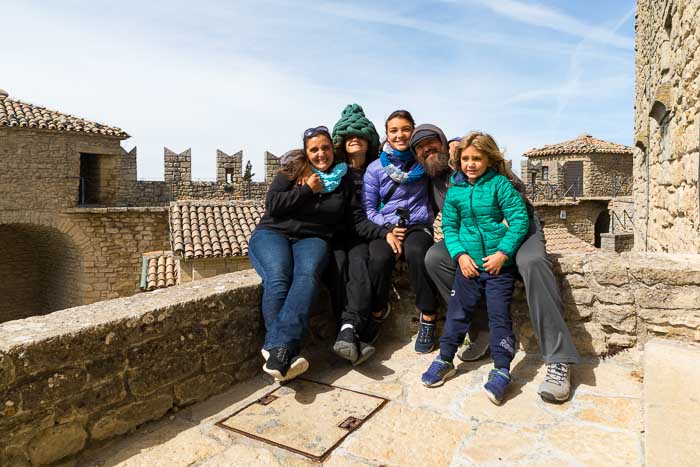
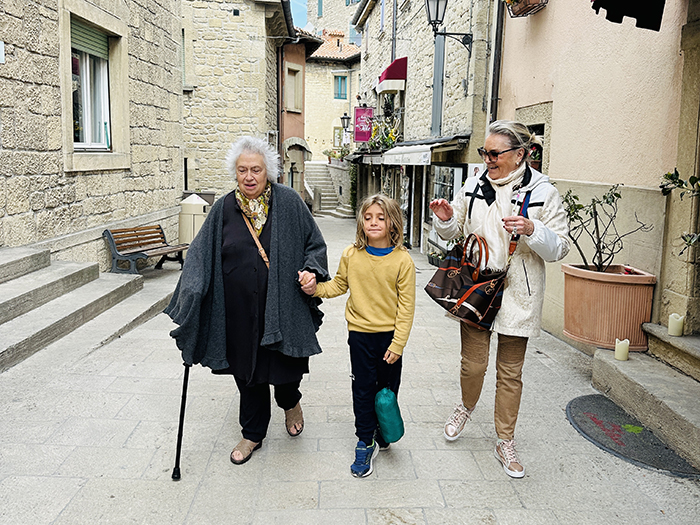
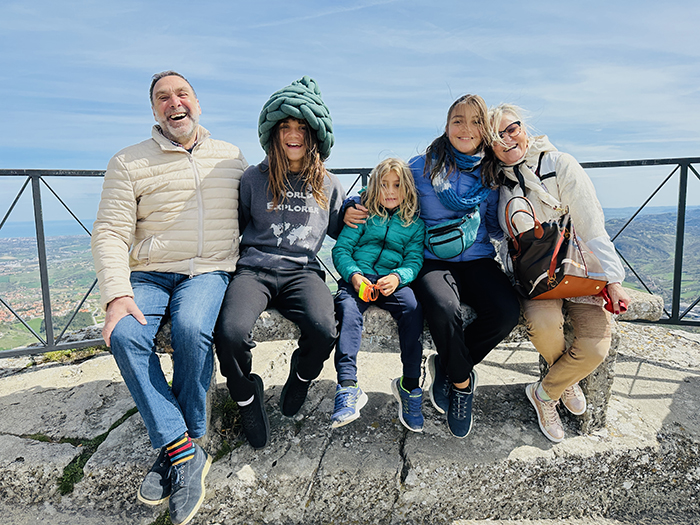
Our visit wasn’t accidental or rushed. We had intentionally planned two days in San Marino because this time, we weren’t traveling alone; we were bringing all the grandparents with us. That choice alone changed the pace of the trip.
What we thought would be a calm, easy destination suitable for multiple generations turned into something much more profound. Those two days didn’t just show us San Marino; they reshaped the way we approach small towns, or in this case, entire countries, that are so often reduced to “perfect day trips.”
San Marino is best discovered slowly, especially when shared. Giving it more than a few hours, staying the night, walking without urgency, allowed us to experience it together, in a way a day trip never could.
About San Marino 🇸🇲
We drove about three hours from Florence, watching the Tuscan countryside gradually soften and shift as we approached a country many people don’t even realize exists as its own nation. There were no dramatic signs, no checkpoints, no passport control, no clear moment marking where Italy ended, and San Marino began.
And yet, it did.
San Marino is a landlocked microstate, entirely surrounded by Italy, perched on the Adriatic side of the peninsula, and built around Mount Titano. When you see it from a distance, it almost feels unreal, with stone towers appearing through the mist and old walls built right into the cliffs, as if the mountain itself is holding its history.
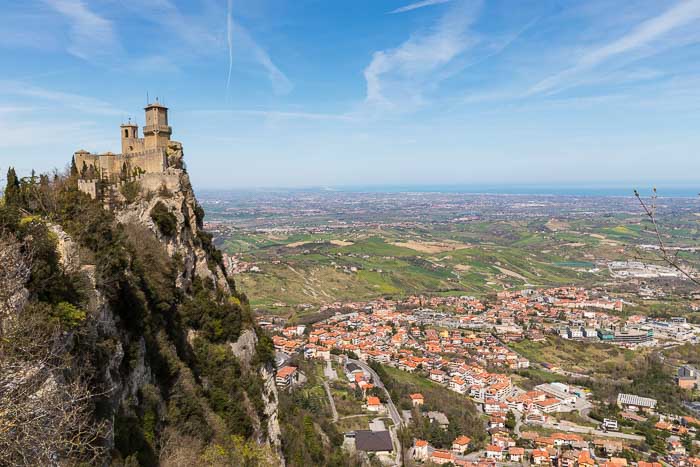
San Marino is small, but it doesn’t feel small when you’re there. It feels welcoming and easy to be in.
Before diving deeper into our experience, here are a few cool details that make San Marino truly unique:
- It is the 5th smallest country in the world and the 3rd smallest in Europe
- The total population is around 33,000 people
- It has been a republic since 301 AD, making it the oldest surviving republic in the world
- The official currency is the Euro, even though San Marino is not part of the European Union
- There are no border checks when entering or leaving the country
- If you want a passport stamp, you can purchase one for €5 at the tourist office
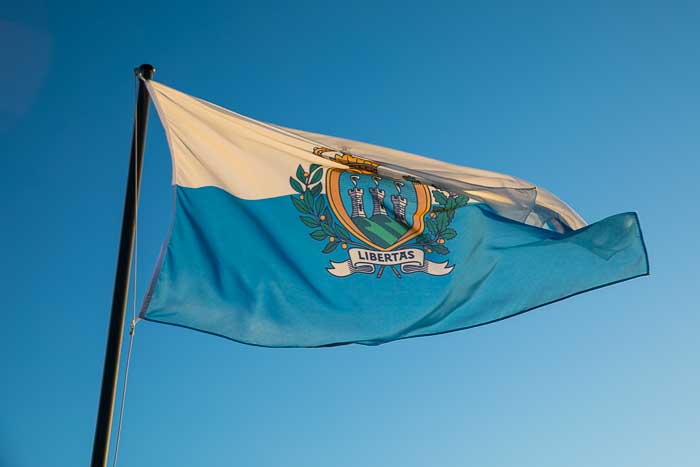
- On the flag, blue represents the sky, while white symbolizes the snow on Mount Titano
A small country with a long history.
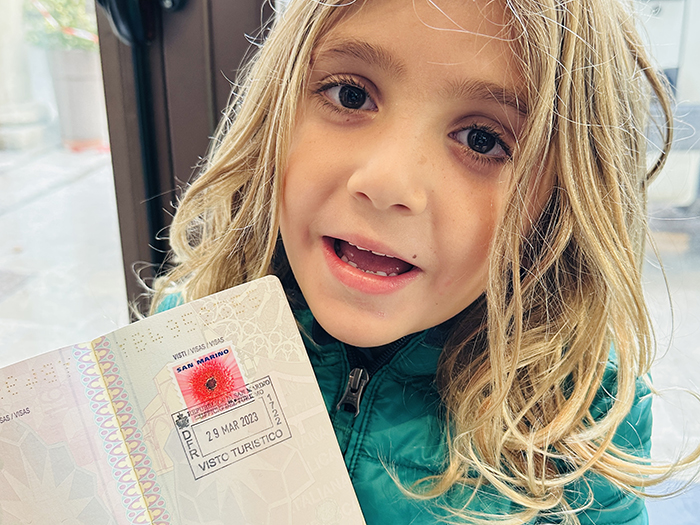
And perhaps most fascinating of all, San Marino has managed to preserve its independence for over 1,700 years while surrounded by another nation.
Which leads to the question everyone asks.
Why isn’t San Marino part of Italy?
We heard this question again and again, sometimes from fellow travelers, from our own kids, and from ourselves as we walked through the historic center.
According to legend, San Marino was founded in 301 AD by Marinus, a Christian stonemason fleeing religious persecution. He sought refuge on Mount Titano, where a small community formed around him. Over time, that community grew, not through conquest or expansion, but through resilience.
While surrounding territories were absorbed into empires, duchies, and kingdoms, San Marino survived by doing three things exceptionally well:
- Remaining neutral
- Choosing diplomacy over conflict
- Never surrendering its autonomy
San Marino didn’t try to compete with powerful neighbors. It didn’t seek to dominate. Instead, it quietly protected its independence through consistency, strategic alliances, and a deep respect for its own institutions.
When Italy unified in the 19th century under Giuseppe Garibaldi, San Marino offered him refuge during a critical moment. In return, Italy respected San Marino’s sovereignty, a respect that continues to this day.
The two countries remain closely connected politically and economically. They share infrastructure, borders, and daily life. And yet, San Marino has never been absorbed.
It stands as proof that independence doesn’t always come from force. Sometimes, it comes from steadiness.
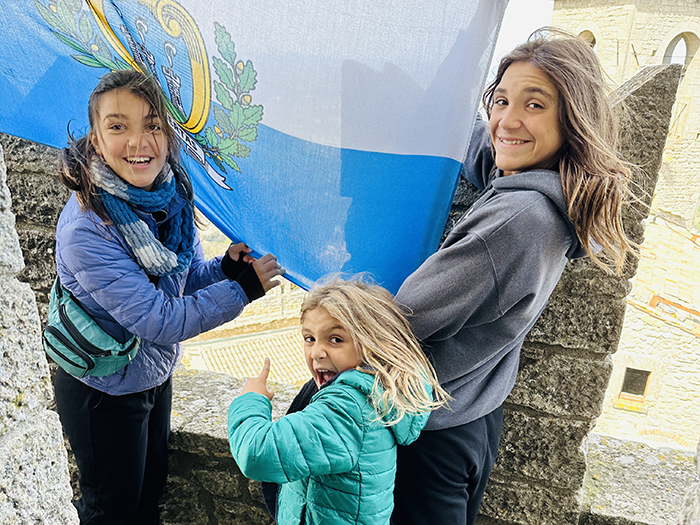
Day 1 in San Marino: Arrival and a Crucial Tip
There’s one thing we believe is the single most important tip for visiting San Marino:
👉 Don’t make it a day trip!
Most visitors arrive late in the morning, wander through the historic center, take photos at the towers, grab lunch, and leave again by late afternoon. And while San Marino is undeniably beautiful during the day, that’s also when it feels the most crowded and rushed.
Then evening comes.
The buses leave.
The streets begin to empty.
And the atmosphere shifts.
At night, San Marino feels completely different.
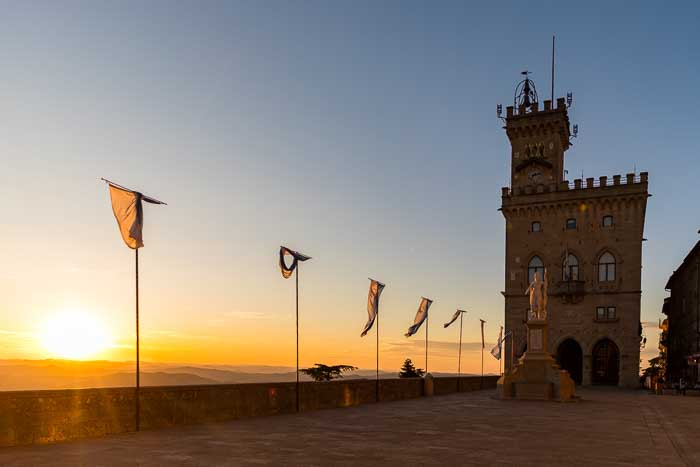
The stone streets grow quiet, lights glow softly against the medieval walls, and the historic center slowly returns to its natural rhythm. Locals linger. Conversations soften. The mountain air cools, and everything feels more grounded, more real.
That first evening gave us a completely different understanding of the place. It felt less like a destination and more like a living country, one that doesn’t exist for tourists, but allows visitors to pass through its daily life.
We arrived in the late afternoon, parked the car outside the city walls, grabbed our luggage, and rolled it into the historic center where we were staying for the night. La Grotta Hotel was a small and charming hotel, but like many places in San Marino, it could only be reached on foot.
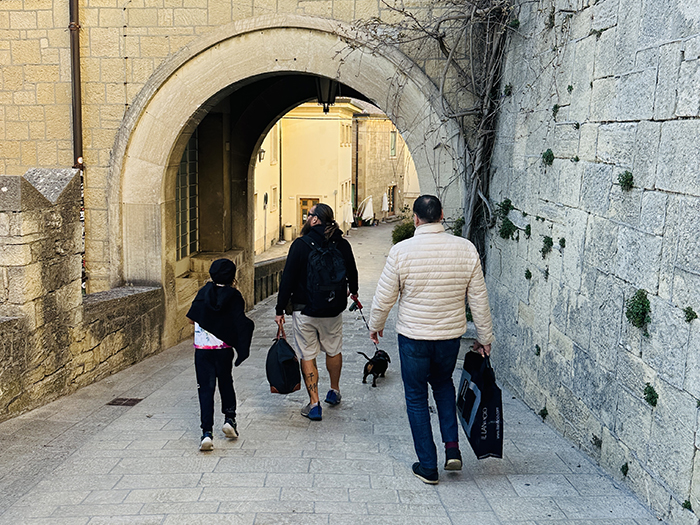
As we dropped off our bags and stepped back outside, most of the day visitors were already leaving. The streets were growing quieter by the minute. We walked without a plan, without crowds, and without any sense of urgency.
That’s when San Marino really started to stay with us.
While wandering through the historic center that first evening, we came across the arrival point of the San Marino Funicular, the cable car that connects Borgo Maggiore, the lower part of San Marino, to the historic center at the top of Mount Titano.
It immediately made sense. The funicular allows people to move easily between the lower town and the old city without driving up narrow, steep roads or tackling a long climb on foot. It’s especially helpful for families, older travelers, or anyone who wants to enjoy San Marino at a slower pace.
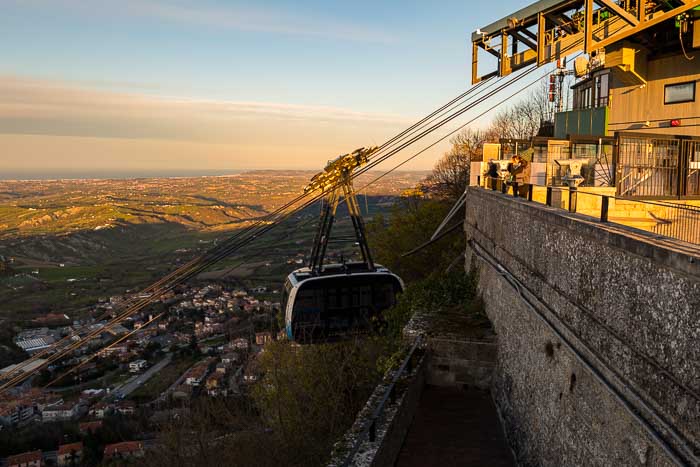
Watching it arrive and depart quietly in the evening felt like another small detail that revealed how thoughtfully this country is set up for daily life. Seeing it in action helped us understand how locals and visitors move through San Marino day to day, and it made the historic center feel even more connected to the life happening below.
Day 2: Exploring the Towers, Museums, and Unexpected Surprises
Our second day was all about exploring San Marino beyond first impressions, starting with one of its most iconic features: the three towers.
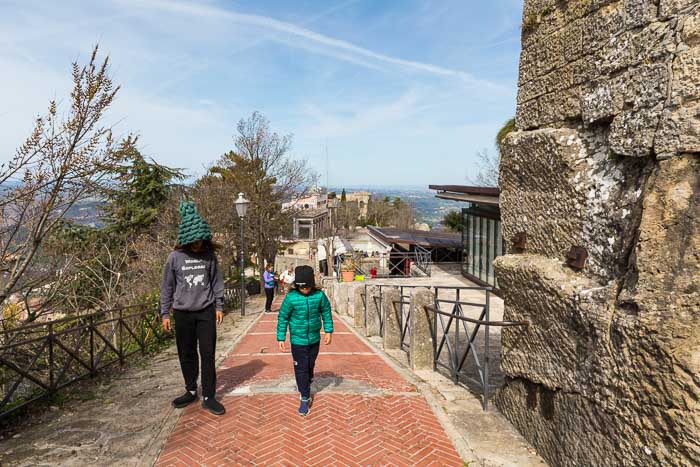
The towers are the symbol of San Marino; they appear on the flag and are deeply connected to the country’s history. Each of the three towers plays a different role in San Marino’s history, and understanding that makes visiting them feel much more meaningful.
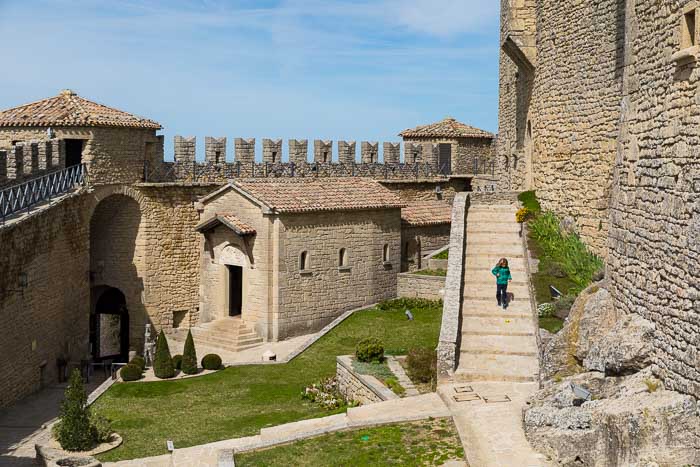
Guaita, the oldest of the three, dates back to the 11th century and once served as both a fortress and a prison. Climbing it feels real: narrow stone passages, steep steps, and multiple levels opening up as you go higher. It’s not polished or modern, and that’s precisely what we loved about it.
Cesta sits at the highest point of Mount Titano and today houses the Museum of Ancient Arms, which features a surprisingly large collection reflecting centuries of defense and independence.
Montale, the smallest and most isolated, isn’t open to visitors, but it was built as a lookout and prison. Even from the outside, it feels symbolic—quietly standing guard over the landscape.
Together, the towers are so crucial to San Marino that they appear on the flag and coat of arms, representing freedom and resilience, values that still feel very present when you walk between them.
You can only enter Guaita and Cesta, but you can walk to all three towers along the Passo delle Streghe, or “Witches’ Path,” named after old legends that witches once gathered along this narrow ridge. Whether the stories are true or not, the dramatic cliffs, exposed stone path, and sweeping views make it one of the most memorable walks in San Marino.
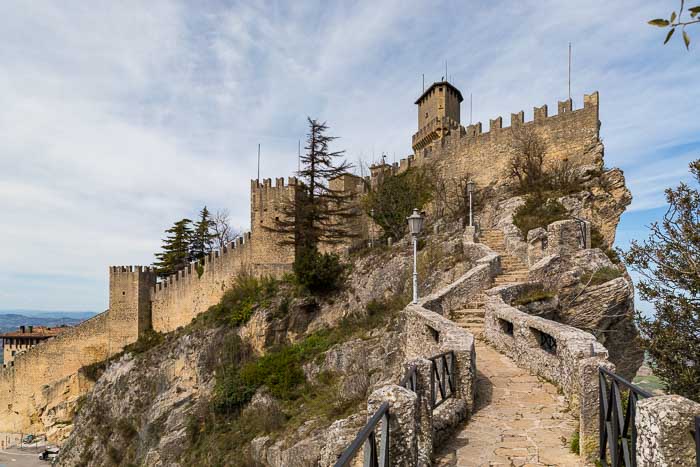
The path follows the natural shape of Mount Titano, winding along the ridge where people once walked for defense and communication. It’s easy to see why this route was so crucial to protecting the republic: steep drops on either side, expansive views of the countryside, and a clear sense of how strategically important this location was. On a clear day, you can even see all the way to the Adriatic Sea.
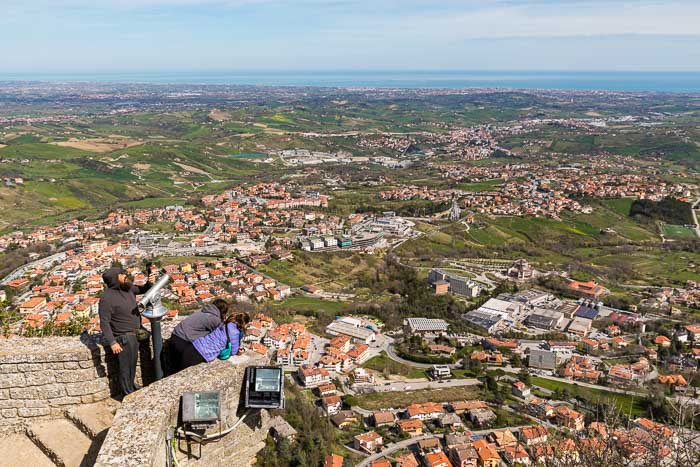
This walk alone is worth staying overnight for. It’s peaceful, dramatic, and best enjoyed slowly. While some of us made the full walk, my mom chose not to join because walking can be difficult for her. Instead, she found a café with a beautiful view and enjoyed the moment from there—proof that San Marino can be experienced in different ways and at different paces.
One of our favorite moments was exploring Guaita Tower. Climbing it felt like stepping back in time, with narrow stone passageways, steep steps, and different levels opening up as you go higher. It’s not polished or modern, and that’s exactly what makes it special; you can really feel how this tower once served as protection and a lookout over the land.
With our combined museum ticket, we also visited the coin and stamp museum, which turned out to be far more interesting than we expected. Through currency, stamps, and symbols, we could trace San Marino’s identity—how it represented itself to the world and maintained its independence over centuries, despite its size.
And then there was the vampire museum.
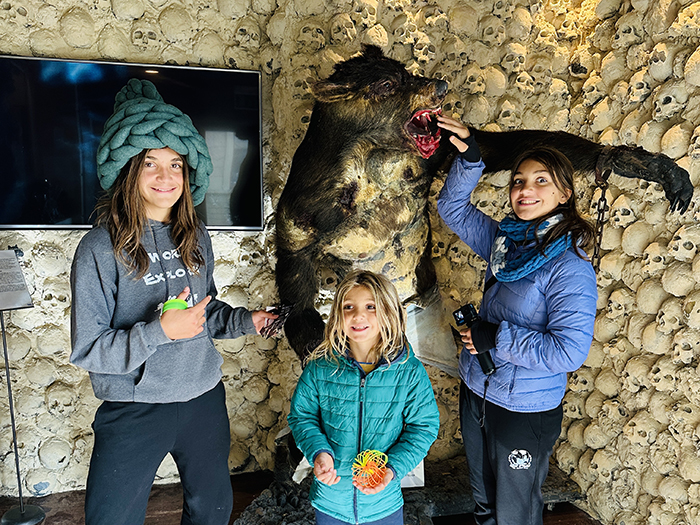
A stop requested entirely by our kids.
We’re still not exactly sure why.
But their reactions, half curiosity, half laughter, made it one of the most memorable moments of the day. Travel isn’t always about loving what you expect to love. Sometimes it’s about letting the unexpected become part of the story.
And in San Marino, that felt perfectly fitting.
Seeing San Marino in the Morning
Waking up in San Marino feels very different from just visiting it for the day.
The morning light slowly reaches Mount Titano. The streets are quiet. Cafés begin to open. There’s no rush, no crowds, no plan to follow—just time to move slowly and notice where you are.
This is when San Marino feels the most real.
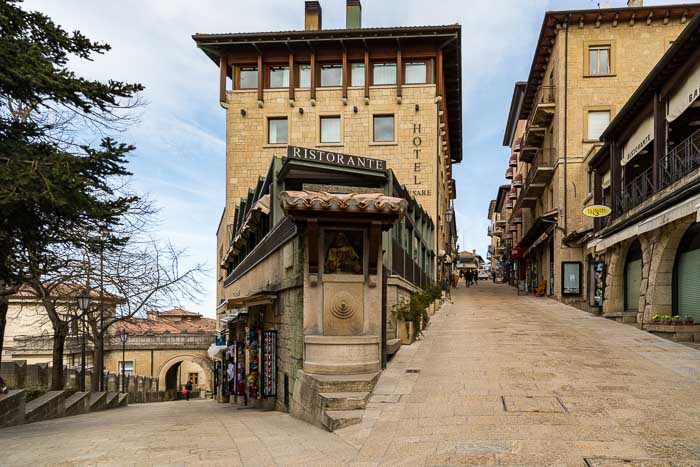
Staying overnight let us experience the country as more than something to see. We watched locals start their day, walked streets that had been busy just hours before, and felt what it’s like when a place isn’t trying to entertain anyone.
San Marino doesn’t try to impress.
It doesn’t compete with Italy.
It doesn’t demand attention.
It simply exists, calm, grounded, and comfortable in what it is.
Visiting places like San Marino reminds us of another small country we loved exploring as a family, Luxembourg, where every corner felt rich with history and daily life, despite its small size. That’s the kind of experience that stays with you long after you leave.
If you’re visiting Italy and wondering whether San Marino is worth the detour, our answer is yes.
But only if you stay.
Because sometimes the smallest places leave the biggest impression, and sometimes the ones you almost skip are the ones that stay with you the longest.